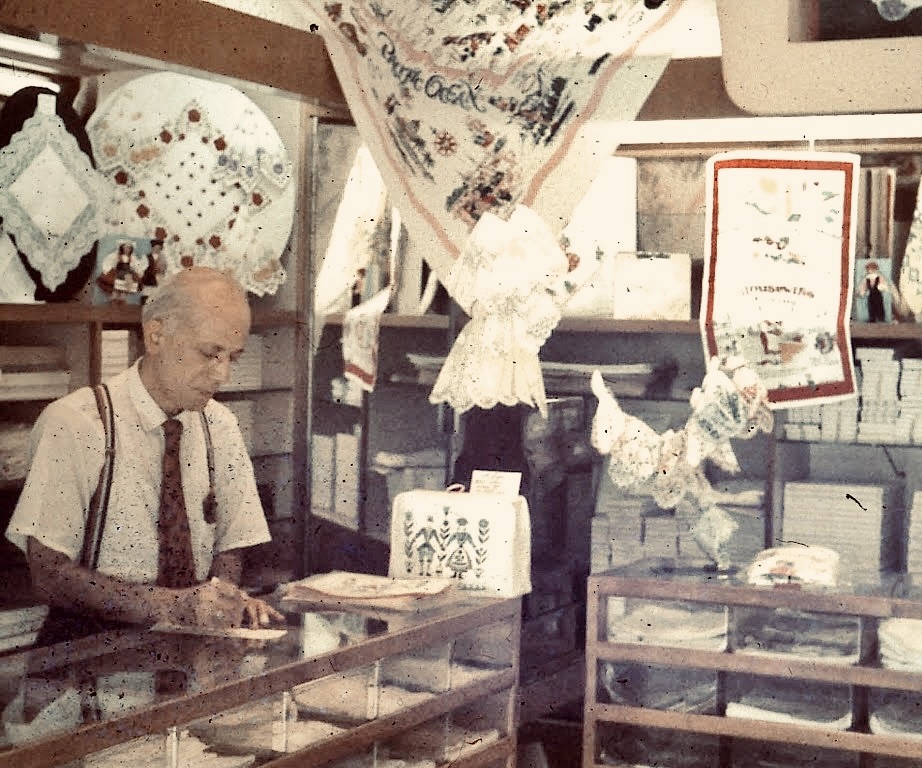
I have a picture of my dad in mind. He’s wearing a white short-sleeve shirt, brown slacks held up by suspenders, a tie, and shiny brown shoes. It’s what he wore to work almost every day. The words “dad” and “work” are synonymous with me.
He took the bus to downtown Los Angeles to his small retail linen store six days a week for years and years. He was in control at his store, whereas at home my mother was the boss. What a great salesman Dad was. A woman would walk into the store for, say, a handkerchief, and he’d have her buying that, a tablecloth, and an apron before she left. He accomplished this feat without being pushy at all. At home, though, he didn’t say much, except to complain about business being slow.
My dad was a kind, thoughtful, honest man. He was religious in that every morning he’d read the Torah with the leather phylacteries wrapped around his left arm and around his forehead. My brother Albert was the only one of his six boys to follow his example.
My dad, Raymond Sutton, was a strong man (supporting his wife and six boys), a weak man (drinking alcohol on the sly), a short man (5-foot-5), a thin man (he didn’t eat much), and a man I rarely communicated with.
During the month of July in 1957, Dad and I were the only ones at home. I was 17, he was 57. Mom and my younger brother Albert had flown to New York to be with her family after her father had passed away. She left a month’s worth of food in the large freezer in the pantry. Before she left, she taught me how to cook white rice.
For breakfast, I would squeeze Dad a glass of orange juice, make a cup of coffee, boil an egg and toast a slice of bread for him. While he was eating, I would put together a sandwich for his lunch.
After he left the house, I was on my own for the rest of the day. I would drive a mile to Fairfax High to workout with the other guys on our football team. After the workout I would drive over to my friend Nate’s house and we would throw the football around or drive to Santa Monica beach to swim in the ocean. Then, in the late afternoon, it would be time for me to get home to prepare dinner for Dad. That was a must, because he never once ate in a restaurant his whole life because he ate only kosher food.
Dad would get home around 6:30, the Los Angeles Herald neatly folded in his hand. We greeted each other at the front door with a kiss on each other’s cheek. Dinner would be ready: white rice, peas, roasted chicken, and salad. We would sit down, rarely saying anything, and eat while watching the news on TV. After dinner, he would go outside and water the front lawn. I’d wash the dishes and pots and then I’d be free for the night. What I usually did was drive my mother’s car down to Max Himmelstein’s house on 6th Street and Fairfax Avenue to throw the football around with him and Stan Lipkin until it turned completely dark.
Coming home one night, I heard something from Dad’s bedroom other than his snoring. I heard him weeping. What was wrong? Was he disappointed in me for not getting a job that summer? Did he want me to help him at his linen store? Did he want me to stay home after dinner? Was he longing for Mom? Although I wanted to, I didn’t go into his room to find out why he was so disconsolate.
There was very little communication between the two of us that July. In fact, I never had a man-to-man conversation with Dad, and I don’t think any of my five brothers did either. I got to do what I wanted, and I sometimes wondered what he did after I left the house each evening. He probably watched TV, worked on the books, or sat up in his room brooding over his business—or grieving for Mom, who was spending such a long time in Brooklyn mourning her father’s death. He never complained to me and never told me what to do.
We went out to dinner once, not to a restaurant, of course, but to his brother Michael’s and sister-in-law Sarah’s house. All their children were there: Chuck, Leona, Joe, Vic, and Joyce. What I remember most of that night was my cousin Chuck filling his plate with a mountain of white rice, and on top of that he piled kibbeh, peas, and sour soup.
My father, Raymond Sutton, got up at 6:30 every morning and went through the same routine of washing, dressing, praying, eating breakfast, and then taking the bus downtown to his small linen store on 7th and Hill Streets.
He was more himself in that store than anywhere else.