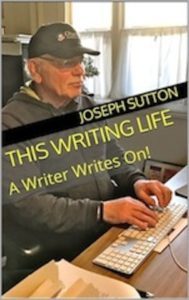
This Writing Life: A Writer Writes On!
 1 – Four Rules of Writing

Rule #1: Sit Down to Write. If you want to write, have to write, need to write, what do you do? Do you go for a walk, wash the dishes or call someone on the phone? No. You can’t do those things if you want to write. What you have to do is actually sit down. It’s as simple as that. Or, if you’re so inclined, stand up. The choice is up to you.
Rule #2: Deadline Yourself. Say to yourself, “I will write a certain number of words or pages today,” or “I will write till I get an idea,” or “I will write for a certain amount of time.”
Rule #3: Write as Fast as You Can. Do you want to break out of a writer’s block or trigger a new writing idea? Write swiftly, rapidly, speedily, full steam ahead, let ’er rip, open your wings, write without stopping—don’t look back until you’ve finished spilling your guts on the page or screen. But let’s say you already have an idea of what you want to write. I say write that idea down as fast as you can and get every bit of it out of your system.
Rule #4: Revise, Revise, Revise. A writer who cares about his readers will revise. Keep revising until you’re satisfied with what you’ve written.
2 – Seize the Time
The following sentence is what I always hear from non-writers or blocked writers, and sometimes from myself: “I’ve been wanting to write but I don’t have the time to do it.”
Dear writers and dear me, you have to seize the time and not let time seize you.
Seize the time to work on your writing ideas, and when you finish them you’ll feel gratified to no end. You will have created something that no one else has ever created. As a result, you’ll be a more confident writer and a happier human being for it.
3 – Just Write
What I’m doing this very minute is exercising my rights and my mind by writing as fast as I can, loosening my subconscious so it can bubble to the surface. Yes, I write, knowing I have to brush my teeth, knowing I have to go to the post office and mail books ordered from my website, knowing I have to visit a few bookstores here in San Francisco and get paid for the books they’ve sold, and lastly, knowing I have to prepare for an upcoming talk to a writer’s group in southern California. I don’t care what anyone thinks of my writing; it’s what I think. That’s what’s most important for this writer: forget what others think, just write.
It’s scary not knowing what you’re going to write. But once you get started it’s one of the greatest feelings to write without stopping, without plotting, without having a purpose other than to write what comes to mind.
In a way I care what I write and in a way I don’t care. I care in that I wish I could be getting a new idea by writing as swiftly as I can, but then it doesn’t matter if I get an idea because I know what I have to do, and that’s to keep writing.
I’m on top of the world when I write as fast as I can. It gives me confidence as a writer. It’s writing. And what do writers do? They write, man, they write.
If you have an idea but don’t know where to start, just start.
If you have a desire to write but don’t know what to write, start writing something, anything—like what I’m doing right now. Just write, don’t stop, keep your pen or fingers moving and don’t look back until you’re finished with the first draft.
Julia Cameron, who makes you want to write if you’ve read any of her books, says, “It is the act of writing that calls ideas forward, not ideas that call forward writing.”
Many times when I sit down, I say to myself, “What am I going to write about today?” and invariably, if I keep writing, an idea will come to mind.
So, if you don’t have an idea to write about, keep writing. I swear you’ll come up with an idea.
4 – Practice, Practice, Practice
I just read an article in this morning’s San Francisco Chronicle that says writing helps the mind stay creative. I might be typing words in my journal that don’t mean anything to anyone, but at least they mean something to me. What do they mean? They’re setting me free. They’re helping me become a better writer. Just like musicians, dancers, athletes and artists practice their craft, a writer has to practice his/her craft. You have to practice and keep practicing. It makes for better writing if you work at it and, as a bonus, you sometimes come up with stories, poems and essays while practicing. It’s happened to me many times.
The most important thing for me to do every day is to write in my journal. When I write it’s good for my mental, spiritual and emotional well-being. It’s food for the soul. What could be more important than that?
Here’s what my friend and fellow writer, Bradley Charbonneau, has written about practice writing: Is jogging (while you don’t want to jog) not jogging? Is making 50 out of 100 free throws worse practice than taking zero free throws? Any action is practice. Here’s what you get from practicing writing every day: Courage. Belief in yourself. Learning from mistakes. Momentum. Motivation. Confidence to keep going. To get better—and better.
5- The Pen vs. the Computer
Today I was reading in my written journal (as compared to my typewritten journal) from 20 years ago and came across a part of an entry that is included in a short story I’m currently working on. That’s why it’s important to write down our thoughts. It just shows that our subconscious is a mysterious storehouse.
So the question arises: Which instrument is best for writing a first draft—the pen or the computer?
Julia Cameron, who’s written many books on writing and creativity, said in an article I read years ago that writing with a pen has more of an impact on a writer than typing. I agree with her. I have found that I remember more when I physically write something rather than type it, even if it’s a little note to myself, like, “Buy fruit and vegetables tomorrow.”
Up until a few years ago I used to write in my journal with a pen all the time. Nowadays I mainly type because typing doesn’t irritate my arthritic wrist like writing with a pen does. Plus, typing is much faster.
So here’s hoping that what I type can equal writing with a pen when the time comes to remember things.
6 – One Way to Get a Writing Project Started
I’m a great believer in keeping a journal, which I highly recommend, for it was while I was teaching in South Central Los Angeles in the late 1960s that I wrote in my journal every day for four months and used those notes to produce a novel about a teacher in a black ghetto high school called A Class of Leaders.
When I was a writer living in Berkeley, my girlfriend and I broke up after living together for four years. A month later, I witnessed the death of my father in Los Angeles. To overcome those two crushing losses, I decided to hit the highways of America in my VW bus to get my head straight. I wrote in my journal every day on that three-month journey. After settling in Portland, Oregon, I used those entries to write my second novel: Highway Sailor.
For my third novel, Morning Pages, about a writer overcoming writer’s block, I wrote in my journal every day for three months and used those entries for the book.
Do you see a pattern how those novels came into being? I wrote in my journal every day for three or four months.
I’m not saying you should follow my pattern of getting material to write about. What I’m saying is, if you write in your journal every day for a month or two or three, it’s one way to get a writing project off the ground. At the very least you’ll have plenty of material to work with.
7 – How to Write and Love Doing It
A lot of people are hesitant to write because they feel that every word has to be perfect the first time out; that whatever they write is like taking a test in school. In short, they think writing is a chore. This is a fallacy.
I say a person would love to write if he or she feels free and loose and could write down anything that comes to mind. This is called stream of consciousness writing, writing as fast as you can without holding back any thoughts or feelings.
Get it all down, as swiftly as you can. Don’t fret and mope, but feel free and loose. If you want to make something out of what you’ve written, start revising and shaping your work. That’s how to write and love doing it at the same time. It’ll be a fun thing to do instead of a chore.
8 – William Saroyan
Charles Deemer, an old friend and fellow writer who, while I was living in Oregon in the mid-1970s, gave me a William Saroyan story collection called The Daring Young Man on the Flying Trapeze. “I think you’re going to like Saroyan,” he said.
Charles was absolutely correct. I not only liked Saroyan, I was bowled over by his simple down-to-earth voice, and soon afterwards I started reading every Saroyan book I could get my hands on.
Why did Saroyan hit the bull’s-eye of my heart? He portrayed real life people in his stories. He wrote about the salt of the earth: a shoemaker, a barber, an American Indian, just to name a few. His stories came out of his life experiences. That’s how I write—from my life experiences.
Saroyan didn’t use newspaper articles as a source of inspiration like Jack London; he didn’t delve into science fiction like Ray Bradbury; nor did he use violence or killing like so many writers have done and still do. Saroyan was a real man, a real writer; he wrote from his own life experiences.
Note: I just counted all the Saroyan books in my bookcase. I have a total of 62 books that were either written by him or written about him.
9 – Writing as Therapy
My wife Joan and I are on a Southwest Airlines flight taking us from Chicago back to San Francisco. There’s a girl of six or seven and her mother sitting across the aisle from us. The girl has an incredibly loud, screechy voice. Joan didn’t have to listen to the torture that I went through for the first two hours of the flight because she was plugged into her iPod the whole time. I couldn’t think straight until she dug into her purse and handed me a pair of earplugs.
There is no doubt that the young girl is in love with the sound of her voice, which happens to be piercing. My ears rang every time she opened her mouth. The mother was so unaware of her daughter’s penetrating voice. That voice not only infringed upon my eardrums and thoughts for two hours, but I’m sure it’s still affecting every passenger in our general area.
I can see that the mother still hasn’t told her daughter to relax and be quiet. I believe she refuses to do so because she thinks she’s a caring, loving mother who is trying to make her precious and precocious little daughter forget that we’re 36,000 feet in the air on a scary, bumpy flight to San Francisco. I blame the mother for not realizing how much her daughter’s voice is bothering others.
Before I got these earplugs, I was almost on the verge of leaning across the aisle and telling that mother and daughter team to “Shut up already!” I looked at those two chatterboxes a few times to show my displeasure, but not a peep came out of me. I was actually too shy to intrude upon their intrusiveness. I’m usually the first person to speak up when unthinking people are oblivious to others. I was hoping another passenger would say something—except no one did. I thought of asking the flight attendant to tell them to be quiet—but didn’t go through with it. It just shows how extremely tolerant people are of children on planes. It even occurred to me to tell the mother that her daughter’s voice carried so well that I thought she had a great future as an opera singer.
Because of these earplugs, I don’t have to vent my anger on them. Instead, I’m venting my anger on this page, which is the only course an angry writer should take.
10 – Perseverance
Max Coley, University of Oregon’s assistant football coach, called me to enter the first team scrimmage of the 1960 season and I unknowingly gave up my college football career to prevent permanent damage to my knee.
Two days earlier I had injured my right knee in a football drill so badly that I had to be carried off the field. The morning of the scrimmage I overslept, waking up at 8:30 as it was just beginning. I hobbled a few blocks to an empty locker room. Across the hall was the trainer’s room. No one was there to tape my sore, swollen, weak knee. I put my uniform on and limped out to the field. What was I thinking?
I was standing on the sideline when Max looked at me and shouted, “Sutton! Get in on offense!”
Max was giving me a chance to show my ability, but I just stood there, my helmet in hand and shook my head. He yelled, “Get in on offense, Sutton!” and again I shook my head. He started for me. “Sutton,” he thundered on that hot, humid Saturday morning, “you’ll never play for the University of Oregon as long as I’m coaching here!”
I didn’t say a word to him because the coaches were always stressing that they didn’t want to hear excuses. I should have at least explained to him, afterwards in private, why I refused to enter the scrimmage, but never did.
In the two years I played for Oregon, Max broke his word four times: he let me in against Stanford and Michigan my junior year, and against UCLA and Notre Dame my senior year. It was in the Notre Dame game, in front of a packed house in South Bend, Indiana, that I caught our quarterback’s deflected pass in the last minute of play and ran 88 yards for the winning touchdown. It was the one and only time I got my hands on the ball in a game, something I’m extremely proud of to this day. Do you think Max complimented me? Hell no!
Even though he thwarted my football career, I learned one of the great lessons of my life at Oregon. It’s the major reason why I’m still writing today. The lesson I learned was perseverance. That’s what all writers have to learn: Perseverance.
11 – How to Gain Confidence as a Writer
While being interviewed on the Charlie Rose show, George Clooney said, “It was luck that helped me break out of the pack.” Before breaking out of the pack Clooney was a struggling actor who supported himself as a waiter.
Luck is a major factor in getting published. I know whereof I speak. My first publisher, Hay House, in 1991, told me that Words of Wellness: A Treasury of Quotations for Well-Being was what they were looking for when my query letter and sample quotations arrived at their office in the days of snail mail. Luck!
When I began my writing career I wanted to be as good as any writer that ever lived. It wasn’t until many years later that I realized I was as good as any writer that ever lived.
And you, all you unknown writers out there, whether published or unpublished, you, just like me, are as good as any writer that ever lived. That’s what you have to plant in your mind if you’re a serious writer. It doesn’t matter if it’s true or not, you still have to fervently believe you’re the equal of any writer because what you believe is up to you and no one else. Holding a belief like that breeds confidence. You shouldn’t have to wait as long as I did to start thinking that way. When you have confidence you write freely and loosely, you’re not worried about an outcome; you’re putting words down for the joy and pleasure of it. And what arises out of that joy and pleasure is discovering a part of yourself you never knew existed. You’ll say to yourself, “Did I write that? I didn’t know I could write so well.” Confidence, by the way, leads to more production on your part.
You’re the equal of any writer because you either struggle or don’t struggle putting words and sentences together. Writers are human beings. They wake up in the morning or afternoon, have their coffee, breakfast, cigarette, alcohol or drug and get to work, just like you and I get to work. They write down their thoughts and produce stories, poems, plays, essays and novels, just like you and I do. Who’s to say that their thoughts and imaginations are better than ours? Why even think that any writer is better than you? They’re not. If they’re famous, they just had luck on their side.
Hemingway, Whitman, Twain, Angelou and Cather wrote words and they became famous for their unique voices. Well, you too write words and were gifted with a unique voice, which makes you the absolute equal of those writers. The only difference is, they became famous. Tell me, what is fame other than luck and ability? As long as you have a passion to write and confidence in your ability, that’s all you’ll need to keep going as a writer.
Here’s what it all boils down to: you’re as good as any writer—that is, if you take writing seriously and have confidence in your ability. All you need to do is write and keep on writing and maybe someday luck will be on your side.
12 – The Burden of Guilt
Even though the following piece has little to do about writing, I felt an urge to add it to this book because it’s a true story and, as you’ll find out in chapters to come, I like writing true stories.
I recently drove down to southern California and gave a talk to a hundred or so members of the Ventura County Writer’s Club. Neal Shapiro, my old high school classmate and president of the Writer’s Club, invited me to speak to the group. My talk consisted of two parts: part one was to elaborate on my “Four Rules of Writing” (see Chapters 1, 2, 3, 4 and 5); the second part was to build up their confidence as writers by telling them they were as good as any writer that ever lived because we’re all endowed with a unique perspective and voice. Due to the response I received, my talk went well. But what I want to write about now is what happened before my lecture, while Neal and I were eating dinner at a restaurant.
Neal and I were football teammates at Fairfax High in Los Angeles. In our senior year all we had to do was win one more game to play in the City Championship.
We were playing Fremont High in the semifinal game and the score was tied with a little less than a minute to play. We had the ball on our 45-yard line. After calling a pass play in the huddle, we lined up and I took the snap from center. Fremont’s onrushing linemen forced me to scramble out of the pocket. That’s when I spotted Eddie Lingo way downfield. While on the run, I threw a perfect pass to Eddie on Fremont’s 5-yard line, where he was immediately tackled. It was the greatest pass I ever threw in my life.
I was so revved up after completing the pass that this is what I said to my teammates in the huddle as the clock was winding down: “I’m the one who got us down here; I’m taking it in.” Those were probably the worst choice of words any quarterback ever said to his team in a huddle.
After lining up, I barked, “Hut one, hut two.” I took the snap from center, moved two steps to my right, faked a handoff to our halfback diving into the line and kept the ball. Before I could turn toward the goal line, I got cut down by a huge Fremont lineman who banged into my right thigh with such great force that I had a hard time getting to my feet. I barely made it back to the huddle. We had no timeouts left. I called the next play for our fullback, who scored on the last play of the game.
It was a great victory for us and it got us into the Championship game—except the contusion of my quadriceps was so severe that I couldn’t even practice the following week. I visited our team doctor two days before the game and pleaded with him to shoot my thigh with a painkiller. He refused. I had to watch the most important game of my life standing on the sideline in my street clothes.
As Neal and I were eating, he said to me, “I remember tackling you in practice the week of the championship game and breaking your ankle. It was because of me you couldn’t play. It ruined our chances of beating San Pedro. I felt terrible about that, Joe. I hope you can forgive me.”
“Neal,” I said, “you didn’t break my ankle. It wasn’t your fault that I couldn’t play. I called my own play in the huddle in the semifinal game against Fremont and injured my thigh so badly I couldn’t even suit up for the San Pedro game.”
“Are you sure it wasn’t my fault?”
“Positive,” I said. “I got my comeuppance for saying something in the huddle that I never should have said.”
“What did you say?”
“‘I’m the one who got us down here; I’m taking it in.’ It was very selfish of me to say that because I wanted to be the hero and it backfired on me. Trust me, Neal, it wasn’t you who kept me out of the championship game; it was my ego that kept me out. I hereby absolve you of all guilt, my friend.”
“Wow, Joe, I can’t tell you how glad I am I invited you to speak tonight. I’ve been carrying that guilt around with me for all these years.”
“Just like I regret saying what I said in the huddle. You were in that huddle. Do you remember what I said?”
“How do you expect me to remember what you said after all these years? Even if I did remember, you said it in the heat of the moment. We were on the verge of getting into the city championship game; we all wanted to score. The only memory I have is we scored the winning touchdown just before the gun sounded.”
“Are you sure you don’t remember?”
“Joe,” he said, “you are hereby absolved of all guilt.”
13 – Writing is an Occupation
When I decided to become a writer at the age of 29, I automatically sat down and wrote every day. I figured if I were a writer, I would take my job as seriously as any teacher, preacher or engineer. Therefore, I contend that a real writer doesn’t write when he feels like it, he writes five, six, seven days a week because it’s his occupation and not a hobby.
Here’s my advice to future writers: If you write at least five days a week, you will produce many books, stories, essays, articles and poems in your lifetime. If you stick to it, there’s no doubt you will someday be published, or you’ll publish your own work.
14 – Procrastinate
I was going to get to today’s writing as soon as I finished breakfast, but guess what? I procrastinated by vacuuming all the carpets in the house and then worked in the front yard trimming bushes and getting on my hands and knees to pick weeds. What I did reminds me of an E.B. White quote: “I walk around, straightening pictures on the wall, rugs on the floor as though not until everything in the world was lined up and perfectly true could anybody reasonably expect me to set a word down on paper.”
That’s it, folks, procrastinate. I put it off, put if off, put it off, until I forced myself to sit down. And then, after sitting, I delayed even more by cleaning my keyboard and computer screen, checking my email and answering a couple of them, signing a bunch of political petitions and watching a short film on YouTube that a friend wanted me to check out—and finally, finally, I got to work.
15 – Overcoming Writer’s Block
Sometimes I say to myself, “I want to write about a certain subject except I don’t know what to say. I’m lost. Here I am, trying to inspire others to write and I can’t think of anything to write. What’s wrong with me?”
This is what is known as a case of writer’s block: a thick concrete wall that stands a hundred feet high and extends miles to the right and miles to the left. You can’t go through the wall and you can’t go over it or around it. “What am I to do?” I ask myself. “I’m stone-cold blank.”
But before I start writing, a question arises: “Should I force myself to write about, say, this homeless poet I know, or should I write whatever comes to mind?” And I answer myself by saying, “If I have to force myself to write about the poet, forget it. What I’ll do is write whatever comes to mind.”
Uh-oh, but here comes the writer’s nemesis, the editor, who says, “You can’t write what comes to mind, it won’t make sense. There are certain rules to follow in writing, and one of them is you must plan ahead by making an outline. And then you must think of a topic sentence to get started on the right track.”
I say baloney to anything that prevents a writer from writing. I can write anything I want—and so can you. We have to tear ourselves away from that editor hovering over us. We have to wipe that constricting figure from our minds, take a deep breath and write the first thing that comes to mind—and to keep on writing.
It’s hard for a writer to bust through, climb over or go around that concrete wall known as writer’s block. To conquer it, we have to symbolically dig under it by clawing and scratching our way into our subconscious, forgetting about outlines and topic sentences, forgetting about spelling, punctuation, grammar and all the other rules of writing and letting ’er rip.
16 – When Ideas Come a-Knockin’
Many ideas come to mind when I’m away from my desk. I can be doing anything—loading the laundry, eating dinner, talking on the phone, gardening, reading the newspaper, watching TV, walking or driving—when all of a sudden an idea will pop into my head.
Here’s the thing: I always make sure to write down the idea or remind myself on my smartphone right away. If I don’t do it right away, I’ll not only forget the idea, I’ll regret it.
For a writer, a pen and paper or smartphone are a must to have at all times, even on your nightstand, because you never know when an idea will come a-knockin’.
17 – A Story
I have a story in mind. I already know its name. It came to me when I noticed an old wrinkled lemon sitting by itself in a bowl on our dining room table.
Lenny the Lemon
Lenny looked like an ordinary lemon sitting in a supermarket stall, but he was different from the other lemons in that he had a soul. One day, a woman by the name of Mrs. Heffelfinger was pushing her cart down the aisle when she stopped and picked up Lenny and several other lemons.
A month went by and Lenny started thinking, “Am I going to rot in this bowl before the Heffelfingers use me? I need to be used for something, anything. I don’t know how long I can last.”
All the other lemons had already been put to use. One was used to add tang to a salad. Another was stirred into a bowl of guacamole. Mrs. Heffelfinger squeezed one into a small bowl of warm water to clean and whiten her fingernails. Another lemon was squeezed into a pot of tea. Lenny was the only one left, getting older as each day passed. He didn’t have that bright yellow sheen he once had; his skin was now a dull yellow with wrinkles and dark spots beginning to show.
Lenny was about ready to rot and go to Nowhereland, when Mrs. Heffelfinger noticed him sitting in a bowl on the dining room table all by himself. “I can’t let that lemon go to waste,” she said to herself. “I have to do something with it because nothing should ever go to waste.”
Mrs. Heffelfinger thought and thought and came up with an idea she had never tried before. She picked up Lenny, and just before her knife was about to cut into him, Lenny breathed a deep, happy sigh of relief, knowing that he was finally going to be of use instead of going to Nowhereland.
Mrs. Heffelfinger took Lenny’s seeds and planted them in the backyard. A whole year passed before he turned into a small bush. Lenny eventually grew into a tree that produced, over the years, a bounty of lemons for the Heffelfingers.
I wrote “Lenny the Lemon” as fast as I could (maybe in ten minutes), and kept revising it until I was completely satisfied with it.
18 – New Story Ideas
Here are some ideas that have entered my mind recently:
(1) “The Monkey in the Tree.” When I smoked pot for the first time in the mid-1960s, I asked my friend Nate Wirt how I’d know when I was high. Nate led me to a large window at a friend’s house. It was nighttime. “Do you see that tree?” he asked me. “Yes,” I said. “Do you see a monkey in that tree?” I looked at the tree and said, “Yes, I see a monkey.”
(2) “Rosh Hashanah at the Synagogue in L.A.” I was 11-years-old when the Brooklyn Dodgers and the New York Giants were playing in the 1951 National League playoffs at the Polo Grounds when Bobby Thomson of the Giants hit the “Shot Heard ’Round the World,” a three-run home run with two outs in the bottom of the ninth to win the three-game series that put the Giants into the World Series against the Yankees. My two brothers, two cousins and I—diehard Brooklyn fans because all of us were born in Brooklyn—were devastated that Brooklyn lost the game 5-4. While our fathers and mothers and the rest of the Syrian Jewish community were praying inside the synagogue, my cousins, brothers and I were packed into my cousin Chuck’s 1949 Ford convertible listening to the game, praying that relief pitcher Ralph Branca would get Bobby Thomson out and save the game for the Dodgers. But the Dodgers lost on one of the most dramatic home runs ever hit in Major League Baseball history. I sometimes wonder if it was that incident that led to my being a deist, a belief in a creative force that set the universe in motion and left it to its workings without intervening.
(3) I was thinking of adding a new ending to a story I wrote years ago about Steve Richmond and myself. After David Kahn read the story, he revealed in an email why it was Steve Richmond’s choice not to speak to me when I thought all along it was my choice not to speak to him.
You see, Steve Richmond, in grammar school, told a lie that got me in big trouble. I had to sit in the principal’s office for five days after school for something I didn’t do. I thought Richmond told on me because he was jealous of always losing to my teams in football, basketball and baseball. Because he committed that dastardly act, I vowed never to speak to him. But according to David Kahn, Richmond decided never to speak to me because in a fit of anger I burst out one day on the playground and called him a monkey. His retaliation was ten times worse than my calling him a monkey, even though he did have an oblong face and big ears that stuck out. So from the fourth grade to the ninth grade, Richmond and I never said a word to each other, which made us the fiercest of competitors. I think he actually helped me hone my athletic skills.
(4) I’m thinking of writing a story that my friend Alan Blum told us at our last poker game. He had us on the edges of our seats and held back the punch line until the very end. It was a terrifying story about his almost getting killed when a group of highway patrolmen had their rifles cocked, ready to blast him to kingdom come if he made one wrong move.
Alan, driving his car home at night in the pouring rain, was forced off the road by a bevy of highway patrol cars. After being patted down for a weapon, he was told to lie face down in the mud, his nose in a puddle of water. He said he could barely breathe.
What was going on? Why was he being treated like a fugitive?
It was a case of mistaken identity. Alan was driving a car similar to that of a man who had just killed two highway patrolmen and an elderly couple.
(5) There is something symbolic about a Japanese man and an American man hugging each other after the last out of the 2013 World Series when the Boston Red Sox defeated the St. Louis Cardinals four games to two. Red Sox pitcher, Koji Uehara, ended the Series by striking out the Cardinals’ batter, and then he ran toward his catcher, David Ross, who gave him a joyful bear hug and lifted him off the ground.
Decades earlier they would have been fierce enemies shooting at each other in the Pacific Theater of World War II. But the two had a common goal: beat St. Louis. They did it and rejoiced in the victory, as did the whole Red Sox team—as do all championship teams.
19 – Riffing on Two Beatles Songs
Yesterday I got an idea while conversing with my friend Lou Berman in a coffeehouse. A Beatles song from their Sgt. Pepper album was playing as background music. The idea came to me to write a story about each song in the album. The stories don’t necessarily have to be related to the Beatles’ lyrics, they’ll be what come to mind as I’m writing about a certain song title.
What follows are the names of two Beatles songs, “Fixing a Hole” and “Good Morning, Good Morning.” I didn’t revise either story because I want to show how writing as fast as you can with an idea in mind works:
Fixing a Hole
Fixing a hole—what comes to mind? Rain. A leak. Have I ever fixed a hole? Have I ever stopped a leak? Yes, I have—when there was a torrential downpour in San Francisco many years ago. The drain pipe over our garage came apart and was flooding the garage. What to do? I ran to my neighbor’s house. He had a ladder. Another neighbor joined in to help fix the drain pipe. In the pouring rain, those two men saved our house, or at least what was on the floor of our garage. Those two men, John and Geoff, in a mighty rain, saved the day for me and Joan. It happened more than 20 years ago and I have no memory of how they fixed what needed to be fixed, which kept Joan and me from getting into a deep fix.
I’ve fixed many a hole in my life. It’s not necessarily a hole; it’s fixing what needs fixing—a problem. What problems have I fixed in my life? They are so innumerable that I don’t know where to start. The greatest problem solver, in my opinion, is saying, “I’m sorry.” I’ve said that to my wife many times over the years. “I’m sorry, dear Joan. I didn’t mean to make you feel that way. Let’s stop arguing and hold each other. Believe me when I say this: Everything I’ve done in the past to hurt you, everything I’m doing now that hurts you, and everything I do in the future that hurts you, I am truly sorry for. Please forgive me.”
The key to fixing a hole is to truly mean you’re sorry for hurting someone’s feelings.
A very good friend of mine hurt my feelings one night, and I told him so. What did he do? He apologized, which fixed a hole in our relationship.
Yes, all it takes is “I’m sorry” or “I apologize” to fix a hole where the rain gets in that keeps my mind from wandering where it will go.
Good Morning, Good Morning
“Good morning, good morning,” I say to Kathy Bender our water aerobics instructor as she’s demonstrating to the class the arm and leg movement she wants them to do. “Good morning, Joe,” she says. I enter the pool to join the class. It’s 9:55. As usual, I’m 10 minutes late. “Good morning,” I say to Gary as I paddle by him. I paddle past Marcy. “Good morning, Joe,” she says as I nod to her. I do some warm-up moves as Kathy is leading the group.
Each one of us has a light flotation belt around our waist that keeps us from touching the bottom of the pool. “Get ready to run in place for two minutes,” Kathy announces. “Remember to tighten your abdominals and breath. Ready…run.” I’m finished warming-up and I start running in place as fast as I can with my arms going back and forth and my legs churning as if I were running the hundred-meter dash against the Olympian Usain Bolt. I work out hard, as hard as I can at the age of 75. I want to be in the best shape possible, and so I run and run, remembering to breathe deeply through my nose and letting the air out through my mouth.
“We’re in the home stretch now,” says Kathy. This is when I give it my all so I can finish strong.
The two minutes are up. I’m breathing hard. Vertical in the water, I do a dolphin move in place to get my breath back, while at the same time loosening the muscles in my sometimes sore lower back.
After doing a variety of arm and leg movements and five minutes of stretching, the class is over at 10:45. Since I came late, I stay in the pool to finish up the ten minutes I lost. After finishing, I climb out and walk into the dry sauna. It’s a small sauna and my good friend Bill Hellums is in there. I love talking to Bill because he’s pretty knowledgeable about what’s going on in the world of politics.
After fifteen minutes are up, I leave the sauna and go upstairs to shower. I make sure I don’t use much water because of a very bad drought California is having.
After dressing, I drive home and make my lunch, consisting of cut-up vegetables in a hot miso broth. An hour later, it’s time for me to sit down at my desk and figure out what I’m going to write for the day.
20 – This Writer Learns from His Wife
Where do I find material to write about? I get my material from my ongoing journal of 40 years that I’m writing in this very second.
Most of the time when I start a journal entry I have no idea what I’m going to say. I might begin writing about the weather, how I feel, what’s going on in the world or what’s going on outside my window. Just by putting words on my computer screen, an idea or incident might enter my thoughts. If I think I can make something meaningful out of it, I’ll write as much about it as swiftly as I can before I go back and start revising.
Today is a rare day for me. I don’t have to stumble across something to write in my journal, I know exactly what I want to write about, which is an incident that took place last night at AT&T Park where the San Francisco Giants play baseball. I always treasure writing about meaningful incidents, even those that reveal my flaws.
Joan and I weren’t at the ballpark for a baseball game; we were there to watch the Donizetti opera Lucia di Lammermoor. It was San Francisco Opera’s twice-a-year presentation of Opera at the Ballpark, where all of San Francisco is invited to watch a live simulcast from the War Memorial Opera House on the ballpark’s jumbo scoreboard—for free.
After Joan and I got off the streetcar, we came upon a line that was maybe three blocks long. We went to the head of the line and found that only one entrance was open and only one security guard was checking bags. It was the essence of poor planning by either the ballpark officials or the opera company.
Because we were in for a long, long wait, I wanted to kind of melt into the front of the line, but Joan was totally against it. “That’s not being fair to the people standing in line,” she berated me.
“I’m only trying to get us in before the opera starts. You don’t want to stand out here longer than an hour, do you?”
“It’s not right,” she said. “It’s rude. I’m going to the back of the line. You do what you want.”
I, of course, followed my wife to the back of the line because it was the right thing to do. For ten minutes we barely inched along. All of a sudden the dam broke and within five minutes we were inside the ballpark. The one and only security guard had stopped checking bags so that the crowd could get in on time to see the beginning of the opera.
As it turned out, the two of us, along with 25,000 other people, had a grand time watching the opera on the Giants’ jumbotron scoreboard.
21 – A Writer’s Workshop
Last night I met a woman by the name of Kathy Dalle Molle at a book reading at Folio Books in the Noe Valley District of San Francisco. After Kathy introduced three readers who read from their books, she explained her upcoming workshop to the crowd. And guess what she’s calling it? Write Now. She gave the workshop that name after reading my book Write Now! It blew my mind. She told us the workshop would consist of a member picking a subject out of many subjects in a hat and having the group write as fast as they can for 10 minutes. The group will do three of these in one session and read what they’ve written to the group. In other words, Kathy believes in fast writing like I do. I was so thrilled she named the workshop after my book that I signed up for three sessions.
22 – Feedback
I believe getting feedback for your writing is necessary. It’s a good idea to have someone else read your work before typing up a final draft and sending it out.
Who should you show your work to? You can show it to the person you’re living with or to a friend. You can go to a weekly or monthly writer’s workshop. You can email it to someone whose opinion you trust. And finally, there are many editors in the world who are willing to read your work for a fee. As for me, I’ve done all the above.
The important thing is to have someone else read your work so you’ll know if you’re headed in the right direction or not. Another person can tell you if you left out any important information, if any words are misspelled, if you repeat a word or phrase too often, if you should delete or add something, and the list goes on, depending on who’s reading your work.
Be open to criticism, but not too open. Because a college professor criticized a poem of a woman I know, it made her give up writing poems altogether. The flipside of that: a woman I once met wrote a story that a professor of hers complimented to no end. He told her she had great potential and couldn’t wait to read her next story. She said to me, “I felt like I couldn’t live up to his expectations and it crippled my writing.”
The main thing is, don’t ever get down on yourself. If criticism, or even a compliment, makes sense to you, take it. If it doesn’t, forget it.
23 – Why I Self-Publish
Many years ago my editor gave me a little lecture. “You should publish everything you’ve written,” he told me, “otherwise what’s the point of being a writer? If agents aren’t willing to represent your books and publishers aren’t willing to publish them, then go ahead and publish them yourself. Why keep banging your head against a brick wall? Nothing should deter you from getting your work into print. Nothing! Remember, Joe, this life is the only one you’ve got.”
Soon afterwards I became a self-publisher. There was no more trying to get the attention of a literary agent or an editor at a publishing house with a dazzling synopsis of each of my books. There was no more sending out one-page queries by snail mail or email and getting back rejections. I had had it up to here with people who think they know what quality writing is or think they know the pulse of the reading public. I owe it to my editor for making me realize that I didn’t have to take their crap any longer.
I’m a writer, and a writer should get as much of his work into print as he possibly can, or what’s the use of being a writer?
24 – The Life of an Independent Writer/Publisher
I used to enter short story contests where I’d send $5, $10 or $15 checks as an entry/reading fee. What I eventually learned was that I was throwing money to the wind. I don’t receive rejections anymore because I self-publish. There’s no more waiting weeks or months to see if a book, story or article has been accepted or rejected. I’ve self-published many books because I feel my writing is better off published instead of sitting in a drawer going nowhere. The more books I produce the better I feel. It’s my contribution to the grand mosaic of American literature.
Yes, sir, I’m a lucky man that I can publish my own writing; otherwise I’d be sending my work to publishers and agents and getting punch drunk with rejections.
Many great writers have paid to self-publish their own books. Here’s a list of them that I found on Google: Deepak Chopra, Gertrude Stein, Zane Grey, Upton Sinclair, Carl Sandburg, Ezra Pound, Mark Twain, Edgar Rice Burroughs, Stephen Crane, George Bernard Shaw, Walt Whitman, Anais Nin, Virginia Wolff, e.e. cummings, Edgar Allen Poe, Rudyard Kipling, Thomas Paine, Henry David Thoreau, Benjamin Franklin, Alexandre Dumas, W.E.B. DuBois, Beatrix Potter.
Last night at a book reading, I was talking to Maxine Hong Kingston, famous for The Woman Warrior and Tripmaster Monkey. She told me she doesn’t have to worry about promoting her books, that her publisher does everything for her. Since I’ve chosen to be a self-publisher, I have to do everything myself, such as work with an editor, graphic designer, printer, website man and distributor. This is my way of being an independent writer/publisher, not Maxine’s or some other famous writer’s way.
This coming Tuesday I’m going to read at The Green Arcade Bookstore on Market Street.
Next Saturday is Independent Bookstore Day. I was invited to read at my neighborhood bookstore: Bookshop West Portal.
Two weeks ago I went to KNBR-AM, the most listened to radio sports station in the Bay Area, to drop off 12 personally inscribed copies of my Giants book to all the radio hosts at the station. I heard back from one host, Marty Lurie, who said he’d like to do a phone interview with me in the near future.
25 – Promoting/Marketing Books
Today I went to several bookstores and one novelty shop here in San Francisco. The novelty shop took a dozen copies of San Francisco Giants: A Fan’s Journal 2010, 2012, 2014 on consignment. A block away is a bookstore that I’ve been to many times before and, as usual, they took only one copy of my Giants book. That’s all they ever take. Most often a book won’t sell if there’s only one copy on a bookshelf. If they took five or six copies it becomes a display, then it would sell. I’m sure of it.
Outside of Green Apple Books in the Richmond District, I ran into Gwen, a water aerobics classmate of mine. She told me she has a nephew who’s the batboy for the Giants. I immediately gave her a signed copy of my Giants book to give to her nephew so he can show it to the ballplayers. I have no idea if anything will come of this, but at least I’m getting the book out into the world.
While at Books Inc. in the Marina District, I noticed that Steve Hermanos was going to have a reading there next month. Steve writes baseball poems. I’ve used three of his poems as an introduction to my three Giants books (now consolidated into one book). I called him and asked if I could share the floor with him and, without any hesitation, he said, “No.”
Well, at least I tried.
How does a writer market his books without having to spend a fortune? That’s the big, big question facing all self-publishing writers. Over the years I’ve tried many different ways to market my books and only on a rare occasion has it worked.
I see commercials on TV, I hear commercials on radio and come across ads in newspapers, magazines, online and on billboards—plus I receive a lot of junk mail and unsolicited phone calls. That’s what every person in the U.S. encounters every day of his or her life. Hundreds of companies and corporations are hammering at us to get our attention. What I’m trying to say is this: the companies and corporations that run commercials and ads, they have the money to advertise, and so they deluge us day in and day out to buy Toyota, Viagra, Coors, Jack in the Box, Geico or whatever product or service they’re selling.
What is an unknown indie author to do? Well, you can publish your own book or sign up with a Print of Demand (POD) publisher and go around to bookstores and talk them into carrying your book and maybe set up book readings. And you can upload your book for free on e-book sites like Amazon Kindle or Smashwords and hope people will stumble across your book.
26 – I Consider Myself the Luckiest Writer on the Face of the Earth
I’m happy I chose to be a writer. I feel like the great New York Yankee first baseman, Lou Gehrig, who said to an overflow crowd at Yankee Stadium on the day of his retirement in 1939, “Today I consider myself the luckiest man on the face of the earth.” Two years later, he died of ALS, otherwise known as Lou Gehrig’s Disease.
Although I write about writing, I refuse to tell people how to write or what to write. All I can do is try to inspire them to write and give them a picture of what it is to be a writer.
I feel freer than a bird when I write. I can soar, glide, swoop, dive, imagine, feel, think, go back in time, peer into the future or vent my anger when I write. No one is telling me what to do. I’m free. I’m a writer.
I feel like writing a poem:
Imagination
I picture my wife standing in Venice’s famous Piazza San Marco wearing a long black dress, smiling.
I picture my five brothers—Charles, Dave, Bob, Maurice and Al. Charles, the oldest, is no longer with us.
My dad was a great man. He fathered six boys and never once did he fail to provide for us. How can he be anything less than a great man?
My mom had great energy, beauty and a strong voice. She was a real mother. She yelled and hollered, shopped, cooked, cleaned and loved.
My son Ray, I see him ascending a stairway with a bright future ahead of him.
I see William Saroyan at his house in Fresno. He was a tremendous influence on me—and still is. (See Chapters 3, 13, 44)
I’m thinking of Allen Ginsberg’s rant against capitalism and conformity in Howl. He spoke his mind, as all artists should.
Hemingway—he didn’t fill his sentences with lofty words, he wrote simple sentences.
So what is life? I ask myself.
Life is being FOR, not against.
Life is a wonder when the imagination takes hold.
That’s why we must cherish our short existence on Earth.
I love writing. I’m putting my thoughts down, I’m writing without fear, without trying to make a statement or prove a point. I’m just expressing my being. That’s why I consider myself the luckiest writer on the face of the Earth.
27 – Find Your Passion and Let it Soar
My good friend Charles Lewman, in an email, recommended I watch Dewitt Jones, a National Geographic photojournalist, on YouTube. I couldn’t stop going from one short film of Jones’ to another, where he talks about vision, perspective, creativity, love and passion. “Forget money, forget fame,” he says, “just find your passion and let it soar.”
Jones’ philosophy reminds me of what the 20th century mythologist Joseph Campbell stressed when he was alive: “Follow your bliss and the universe will open doors for you where there were only walls.”
I have followed my passion, my bliss, and somehow it has all worked out for me.
I learn so much from Charles Lewman. He’s like an angel sent from heaven. He’s a bright light to me—always listening, asking, encouraging. Both of us grew up in Hollywood. It wasn’t until 2013, when both of us were 73 that Charles, having moved to San Francisco in 2012, phoned me. He found out from a mutual friend that we lived in the same city. We hadn’t seen each other since high school.
There’s a special connection the two of us have that goes back to 1955 when we were playing baseball in front of the Bancroft Junior High student body, all 1,800 of them.
I hit a home run off Charles in that game. It was one of the great athletic feats of my life because it was extremely rare to hit a ball over the fence at Bancroft. Charles’ pitch came right down the pike. The ball cleared the fence, close to the foul line, and as soon as I touched home plate in all my glory, I saw a teacher talking to the umpire. The teacher, only a spectator, was telling the umpire that my home run went foul. And guess what? The umpire listened to the teacher and changed his call from a home run to a foul ball.
Charles, to this day, swears the ball went foul.
What I go by, to this day, is the umpire’s original call—a home run.
28 – The Gatekeepers
Darien Marshall, a radio talk show host in Philadelphia, interviewed me on the phone yesterday. We talked for an hour about writing, the writing process, rejections, writer’s block and how we unknown writers are equal to any writer of the past and present. Why are we equal? Because every writer has a unique voice. We have to trust and be confident of that voice. It took me a long time to realize that.
The subject of publishing and agents also came up in our conversation. Most of the time a writer has to find an agent before he can get a book published. An agent is a gatekeeper or filter for publishers. I tried to get through to those gatekeepers for many years and came up empty-handed. So what did I do? I stopped sending my work to them and said to myself, “I’m tired of getting rejected. I’m now confident as a writer, therefore I’m going to start publishing my own books.”
Forget those highfalutin agents who think they know writing talent. Forget them, because every serious writer has talent. Who’s to say that one writer is better than another? The gatekeepers have that say. But who are they? They’re human beings who read a lot and seek talent. I’m tired of their talent search. I’m tired of their pompousness and holding their noses in the air.
I sounded off about all the above on Darien’s show because I’m a cheerleader for writers. I try to tell them that they’re just as creative as any writer that ever lived. But first a writer has to work at his profession and keep working at it and not get down on himself if he can’t find an outlet. If you can’t find an outlet, there’s always the Internet. It’s a whole new world and it’s time you do something about it—by publishing your own work.
Thank goodness, during my lifetime, I’ve come across self-publishing. It was hard to do before the Internet came along. Now it’s as simple as uploading a book on an e-book site for free for the whole world to read.
29 – This Writing Life
I know that most writers have to work at another job to survive in this world, which leaves them little time and energy to write. I’m an extremely fortunate writer who has the time and energy to write. So let me fill you in on a typical day in this writing life of mine:
I wake up around 7:30 and make my own breakfast. While eating and sipping coffee, I’m simultaneously reading the San Francisco Chronicle and listening to the Murph and Mac sports talk radio show.
At 9:15, it’s time for me to drive to the YMCA for my 9:45 water aerobics class (a.k.a. deep water running). I attend this class four days a week. (In the old days, before my two hip operations, I’d go for a brisk walk down by the ocean five or six days a week. I still walk, but only a couple of days a week now.) After a vigorous one-hour workout in the pool and a relaxing fifteen minutes in the dry sauna, I shower. While dressing, there are always one or two men in the locker room to shoot the breeze with about politics, economics, sports, movies or our health. It’s the only time of day I get a chance to socialize. Along with exercise and proper diet, I believe social interaction is a large part of a human being’s well-being.
After getting home at noon, I put a lunch together.
Around one o’clock, I get to my desk. For several hours that seem to go by too swiftly, I’m doing something related to writing. I’m either writing in my journal to chronicle my past or present life, or I’m writing in my journal as fast as I can to get an idea to write about. If an idea hits me, I’ll write like the wind to get it all down. Then comes the inevitable revising, which can take hours, days or even weeks.
Come seven o’clock, it’s eating dinner with my wife Joan.
Around eight o’clock, I’ll unwind a while by watching the news or a sporting event on TV. I’ll return to my desk around ten o’clock to check my emails and answer those that warrant a reply.
When 11 o’clock rolls around, it’s zzzzzzzzzzz time.
30 – Thanks, Mom
Who or what made me me? Did my mom, Jeannette Sutton, have anything to do with it? You’re darn tootin’ she did!
My dad, Raymond Sutton, came to the U.S. from Aleppo, Syria, in 1920 at the age of 20. He met Mom five years later in Brooklyn, where she was born. They married when she was 18 and he was 26. They had a son, a daughter and then sons 2, 3 and 4. I, son number 5, came into the world in 1940. At my birth, Mom was 31, Dad was 39.
Mom wanted a girl because her one and only daughter Luna died of pneumonia in 1935. “Dear God, please give me a girl,” she prayed while I was in her belly. “I lost my Luna five years ago and now have four boys. All I ask, dear God, is give me a girl.”
My mother hears the nurse exult, “It’s a boy!”
She had prepared pink for my birth and resented me because I wasn’t the girl she so dearly wanted.
A few weeks later, leaving me alone on her and Dad’s bed while cooking dinner for the family, she heard me crying my lungs out. I was trying to tell her, with all my might, “I need your warmth, your breast, your love. If you don’t give me any attention, I’m doomed.”
Knowing that I needed her, she still kept cooking.
I cried furiously until the force of my anger and outrage moved me to the edge of the bed. And then there was complete silence.
She ran from the kitchen into the bedroom and didn’t see me. She rushed to the other side of the bed as a loud “Waaaaaaaaaaaaaaaaaaaa” came bursting forth.
She picked me up off the floor and hugged me, kissed me and nuzzled me. “Please forgive me, my dear little Joe, please forgive me for distancing myself from you. You now have my complete love.”
A year later our family moved from Brooklyn to Los Angeles. Several years passed until son number 6 was born.
While Dad went to work six days a week to his linen store on 7th and Hill Streets in downtown L.A., Mom had to take command of a house with six boys in it. “Joe,” she would order, “mow the front lawn.” “Bob, wash the dishes.” “Charles, set the table.” “Maurice, clean your room.” “David, clean the bathroom sinks.” “Albert, take out the garbage.”
Mom had to do the shopping for eight people. I remember going on shopping excursions with her as a kid, always talking to the head of the produce department at Ralphs on Sunset Boulevard to buy vegetables and fruit in bulk. She had to cook a big dinner every night. She washed our clothes and hung them up in the warm L.A. sun. I want to thank her for showing me and my brothers how to share the workload, how to be teammates.
Mom loved to dance and sing. She could have been Fred Astaire’s dance partner instead of Ginger Rogers if she hadn’t gotten married and had so many kids. She had great energy and set an example for us to eat correctly and to stay in top physical condition.
Thanks, Mom, for all you’ve done. Thanks for all you gave. You passed away one night in your early 80s in a house you lived in for four decades. You died all alone without having a chance to say goodbye to any of us. You were strong to the very end.
Thanks for being a role model for me in both life and in death.
31 – Why I Write
I write because it makes me happy.
I write to find out what I’m thinking, feeling, imagining.
I write to create something out of nothing.
I write to encourage people who want to write but who don’t have the confidence in themselves to put words on paper.
I write to chronicle my time here on Earth.
I write because it gives meaning to my life.
I write to find out where I’m headed and where the human race is headed.
I write to try to make sense of the world.
I write to try to explain my existence in the universe.
I write to extol life, to show how fortunate most of us are to be alive and kicking.
I write because I’m a writer.
I write to be serious, playful and insightful.
I write for future generations to read my words.
I write to present a new and different perspective on things.
I write to ponder the past and foresee the future.
I write to keep my mind active.
I write to tell a damn good story.
I write because I want to, need to, have to.
I write, therefore I am.
32 – The Day I Became a Writer
Millions of people remember the date I became a writer: November 22, 1963, the day President John Kennedy was assassinated. That night, for the first time in my life, I sat down to chronicle my thoughts and feelings. I was 23 at the time.
Six years later I moved from Los Angeles to Berkeley to begin my writing career in earnest. I jumped into it with the passion and gusto of an A student to write a novel about my last semester as a teacher at Fremont High School. I had never taken a writing course in my life. I didn’t know the first thing about the craft of writing. And to this day I still don’t know much about the craft except to make my writing interesting.
The first inkling of my wanting to be a writer came in my junior year in high school. It was after the last game of the 1956 football season. I had played extremely well that day in a victory over our archrival Hollywood High. I was walking off the field with my teammates when Penny Kaplan (see Chapter 47), an attractive girl I hardly knew, came running up to me and started hugging and kissing me. Penny was treating me like a football hero. What a joy it was to be treated that way. All of a sudden this thought entered my mind: I’m gonna write about this someday.
Ron Demonner, a football teammate of mine at Oregon, asked me one day, “What are you going to do in life, Joe?” It was the first time the words “I want to be a writer” came out of my mouth. I said those words out of anger and resentment. I wanted to be a writer so I could exact revenge on my coaches for treating me and my fellow fourth stringers like cannon fodder. I also wanted the world to know that fourth stringers, if given a chance, could be just as good as first stringers.
In the summer of 1965, I traveled through Europe after my first year of teaching in Los Angeles. I was 25 at the time. While in London, I looked up my brother Charles’ longtime friend, Clancy Sigal. I had read Clancy’s autobiographical novel, Going Away, in my senior year at the University of Oregon and absorbed every word of it like a sponge. Seeing him and talking to him, I got an inkling of what it was to be a writer. I saw that he wrote every day, that he read a lot and that he reflected on many things.
Clancy called me during the summer of 1967. He was in New York City and asked if I wanted to visit him. The very next day I caught a plane out of L.A. and stayed with him for three weeks. I roamed the streets of Manhattan during the day while Clancy wrote. At night we ate dinner and talked about writing, politics and life.
In the fall of 1967, Clancy came to L.A. and stayed a couple of months with me in my small one-bedroom apartment. I let him read an unfinished story of mine about a fourth-string football player. “You’re a good writer, Joe. Keep it up.” Clancy didn’t realize that those words would change the course of my life.
In 1965 I was hired as a history teacher at Fremont High School in South Central Los Angeles. The makeup of the student body was 99% black. I taught the traditional way for three and a half years and felt I got nowhere with my students. In my final semester I dropped the conventional methods of teaching: assignments, tests and grades. I wanted them to share their ideas and opinions with each other, a sort of participatory democracy in action. But most of all, I wanted them to learn to be leaders and think for themselves. Teaching their peers would give them a head start in that direction. Whoever wanted to teach could teach, and most of the time, in all five of my classes, there was always a student who volunteered to teach. Some taught several times. Some prepared, others didn’t. Every class discussed the major topics of the day—drugs, premarital sex, the war in Vietnam, police brutality, Black Power, the grading system and capital punishment. Every Friday each class debated the above subjects or other important issues of the day. Every day was a new day, a day of spontaneity in that era of rebellion and creativity. I was finally “teaching” the way I had always wanted to teach. I wasn’t afraid of losing my job because I knew I was going to quit at the end of the school year and become a writer.
Two months after school ended, I was sitting at my desk in a Berkeley apartment I was sharing with a roommate and began writing A Class of Leaders, a novel about a white teacher in an all black high school who lets his students teach. I started writing it on August 20, 1969, my 29th birthday.
I’ve been writing ever since.
33 – Now is the Time of Your Life
I had a great idea for a story last night, in bed, at around three a.m., and told myself to remember it, and lo and behold, I forgot it. I got lazy. All I had to do was turn on my bedside lamp, reach for pen and paper and write it down. Instead, I turned on my side and said to myself, This is a no-brainer. It’s such a great idea I’ll have no trouble remembering it in the morning.
Well, as good ideas sometimes do, like old friends and General MacArthur’s “old soldiers,” they just fade away.
I’m reminded of a William Saroyan short story about a writer who also had a great story idea and forgot it. Boy, that Saroyan was something else! He made a story out of anything and everything.
Last week I went to San Francisco’s Main Library to witness “Celebrating Saroyan,” an event to honor the famous Armenian-American author and playwright. About ninety people were in the audience and we saw a documentary called William Saroyan: The Man, the Writer by Paul Kalinian. We also listened to Aram Kevorkian, Saroyan’s lawyer and great friend before Saroyan passed away in 1981. Kevorkian had us totally entranced when he spoke of Saroyan and his writings. He believed Saroyan was a genius, translating his experiences into art. He said Saroyan had a great understanding of humanity in that all of us are good, bad, ugly and contradictory. Kevorkian went on to say that Saroyan was against religion because religion teaches one to live for the afterlife and not the present, to which I totally concur. He also said Saroyan, like Tom Paine, was against political boundaries. “The whole world was his country.”
Saroyan loved to write, to live, to bring the world together. This is what he wrote in the prelude to his most famous play, The Time of Your Life:
In the time of your life, live—so that in that good time there shall be no ugliness or death for yourself or for any life your life touches. Seek goodness everywhere, and when it is found, bring it out of its hiding-place and let it be free and unashamed. Place in matter and in flesh the least of the values, for these are the things that hold death and must pass away. Discover in all things that which shines and is beyond corruption. Encourage virtue in whatever heart it may have been driven into secrecy and sorrow by the shame and terror of the world. Ignore the obvious, for it is unworthy of the clear eye and the kindly heart. Be the inferior of no man, nor of any man be the superior. Remember that every man is a variation of yourself. No man’s guilt is not yours, nor is any man’s innocence a thing apart. Despise evil and ungodliness, but not men of ungodliness or evil. These, understand. Have no shame in being kindly and gentle, but if the time comes in the time of your life to kill, kill and have no regret. In the time of your life, live—so that in that wondrous time you shall not add to the misery and sorrow of the world, but shall smile to the infinite delight and mystery of it.
Every time I read Saroyan he makes me want to write. No other writer has ever had the same effect on me.
34 – Why I Chose to Be a Writer
Yesterday I spoke to a group of teenagers about writing, and a young lady asked me, “Why do you write?”
“I want to record all the memorable experiences I’ve had in my life,” was my answer.
Yes, I want to write down the experiences of this writer who was born a decade before the halfway point of the 20th century and is still going strong in the first quarter of the 21st century.
Another reason why I write is that I want to be remembered like Tolstoy, Albert Camus, Joyce Carol Oates and thousands of other writers. Writers live forever. I, too, want to live forever. That’s why I originally chose to be a writer. And then, years later, I chose to publish my own books, which made me produce more books than I ever imagined. Because of my output, I wouldn’t trade my life with any other writer, living or dead.
And so it came to pass on August 20, 1969, the day I turned 29 that I started writing my first book, A Class of Leaders. I never wrote a book or a complete story before that day. I never took a class in writing and had no idea what was involved in the craft. If I took a class today I’d probably fail it. I don’t like to be told that there are certain rules and that you have to follow them—if that’s what a teacher in a writing class conveys. Oh, over the years I’ve learned that it’s better to show rather than tell and that the protagonist in a story or novel must change, but I rarely even follow those two rules. That’s why I became a writer, so I didn’t have to follow anyone’s rules except my own.
And so it goes, just like a plane leaving the ground, soaring higher and higher and getting the traveler from one place to another. That’s what I want to do, get from one place to another in my writing without hesitating or stopping for this or that distraction, but to move forward at all times and not look back, Jack, until it’s time to start revising.
On the other hand, all I do in my writing is look back on my life and try to make it as meaningful as possible.
35 – Journal Notes on How I Sold My Novel Morning Pages in 2000
My brother Maurice held a book party for me at his house in Los Angeles. The day was perfect: sun, cotton ball clouds in the sky, clean air, temperature in the low 70s.
Forty people showed up. Everyone bought a book or two or three. I didn’t have a minute to myself.
*****
Last night I read at Bird and Beckett, a combination bookstore and record shop in the Glen Park District of San Francisco. I’d say about 35 people were there. After I read a couple of chapters, there were questions from the audience.
Q. Why is your book called Morning Pages?
A. I named it Morning Pages from the format I used in writing the book. The main character, Ben Halaby, is struggling with writer’s block. He stumbles across a book on creativity called The Artist’s Way by Julia Cameron. The basic principle of Cameron’s book is for an artist, any artist, who is stuck in his work to write three pages as fast as he can first thing in the morning for 84 days.
Q. Is it hard to sit down in the morning to write as fast as you can?
A. The hardest part is to just sit down. Once I sat down the words just gushed out of me. It’s full-speed ahead writing. You forget the censor or editor sitting on your shoulder and write anything that comes to mind. It’s the quantity of words that count, not the quality.
Q. Is there a plot in your book?
A. The main plot is to see what comes out of Ben Halaby’s mind as he’s writing as fast as he can every morning. Each day he writes turns out to be a story out of his past or present life. Halaby doesn’t even realize he’s writing a story a day. After 84 days, if you connect all the stories, they form a novel with a plot.
Q. How long did it take you to write?
A. It took me 84 days or 12 weeks to write the original morning pages. I didn’t even know I was going to make a book out of those pages until I read what I wrote in those 84 days. Gee, I said to myself, I think I can make something of this. I typed up the 84 days and added stories I had written over the years that were related to what I was writing on a certain day. It took me about a year and a half to put the whole novel together and another year and a half to find a publisher.
Q. Is your book completely autobiographical?
A. I’d say it’s about 70% autobiographical and 30% fiction. Morning Pages could be called faction (fact + fiction) or autobiographical fiction.
Q. Do you recommend that all blocked artists use this morning pages method of speedwriting?
A. All I can say is that it helped me break out of a writer’s block. I don’t like telling people that this is the only way to write, but if they’re stuck and want to get unstuck, sure, I’d recommend writing morning pages.
Q. What writers have influenced you?
A. The writers who have influenced me the most are William Saroyan, Jack Kerouac, Henry Miller and Clancy Sigal. All four are autobiographical fiction writers.
Q. If morning pages are supposed to be written without stopping to think, how did you make something out of it?
A. It’s against my nature to let anything go to waste, especially the words I write. So I kept revising what I had written until I finally molded it into a book.
Q. Did you really write every day for twelve weeks?
A. I didn’t miss a day. If I didn’t write in the morning, I wrote in the afternoon or evening.
*****
Tackling the Dreaded Block is an article written by Jonathan Farrell of the San Francisco Bay Guardian
San Francisco writer Joseph Sutton’s novel, Morning Pages: The Almost True Story of My Life, provides a rare glimpse into all the thoughts and feelings a writer has in the quest to do what writers do—write!
Yet there is one obstacle to the creative process that most writers know all too well—the demon known as writer’s block.
In his first novel, released by Creative Arts Book Company, Sutton confronts writer’s block head on. His main character, writer Ben Halaby, faces it by writing at least three pages first thing every morning. His routine requires that he cannot stop writing until he fills up three pages. A simple but very disciplined task. There is to be no stopping or looking back, only continual writing.
“The character of Ben Halaby is, of course, me,” said Sutton. “I can only write from my own experience.”
One of his experiences was battling writer’s block.
“I was suffering from writer’s block and happened upon a stranger I will never forget. She was like an angel. On second thought, maybe she was an angel. We struck up a conversation, and while she talked about her artwork and me about my writing difficulties, she recommended I read Julia Cameron’s The Artist’s Way. She said it helped her overcome her own artist’s block. The next day I went out and bought Cameron’s book.”
Sutton loved the format of a writer writing the first thing that came into his mind. “I dove right in. There’s no holding back on anything and no caring about the quality of words. The main thing is to sit down and write as fast as you can to unleash the subconscious.”
While the primary theme of Morning Pages is about a writer overcoming writer’s block, other themes weave their way throughout the book, such as the complexities of a marriage and fatherhood.
After writing for years without earning much, Sutton, to help support his wife, stepson and newborn son, returned to the teaching profession. He taught in the secondary schools of San Francisco for six years, never once forgetting that he was a writer. Forced out of teaching by stress in 1984, he worked several years as a salesman for a costume jewelry company.
“I did very well as a sales rep,” said Sutton. “I made more money than ever before, but selling costume jewelry left me with a hollow feeling. What I needed was to get back to writing again.”
After quitting his sales job in 1990, Sutton got the idea to compile and categorize inspirational quotations that covered all aspects of health. He plucked 2000 quotations from every conceivable source—books, magazines, newspapers, lectures and even personal conversations. Hay House accepted Words of Wellness: A Treasury of Quotations for Well-Being for publication in 1991.
“The worst part about writing is getting rejections,” confided Sutton. He estimates that in the thirty years he’s been a writer, he’s received more than a thousand of them.
Despite all the disappointments, he is confident his previous works will eventually reach the printed page.
Sutton’s present publisher has already confirmed part of his resolve. Next fall they will be coming out with his story collection, The Immortal Mouth and Other Stories.
*****
The fortune cookie I received at a Chinese restaurant in Berkeley a few days ago is fitting for what is going on in my life. “You have an ambitious nature and will go far because of it.” All I’ve been doing for the past three months is promoting my book. That’s being ambitious.
Here’s the fortune cookie I received today: “You will soon be involved in many gatherings, parties, and communications.” Who makes up these fortunes? The people who create them seem to be right on the mark with me.
*****
I had a successful reading last night at Books Inc. on California Street. Forty people were in attendance. I knew about half of them. Thirty books were sold.
*****
I was at Barnes & Noble in San Rafael last night. Maybe fifteen people were there on a very rainy night. I knew most of them. It was good to see Dave Barry, a lawyer/writer I know from the San Francisco Writers Workshop. It was a pleasure to see Heidi Hornberger. She was the “angel” I met who told me about Julia Cameron’s The Artist’s Way.
*****
I had a great night tonight at the Stonestown YMCA. The crowd was bigger than I expected—about forty people.
Questions flew back and forth, questions about how to get published, about rejections and creativity. One way to use your creativity is to think of what you want to say over a period of time, make notes or an outline and then start writing. Another way, the way I choose, is to write fast and let it all hang out. Here’s my motto: If you get stuck, write like a schmuck.
There are a lot of writers in the world. A lot of them don’t even send their material out because they’re afraid of rejection. If I had to do it again, I would have changed my presentation a wee bit by inspiring those in the audience more than I did. I would have told them, “Don’t be afraid of getting rejected. Send your work out, and if that doesn’t work, send it out again.”
Maybe there’s a reason I’ve gotten rejected so many times in my writing career. Maybe it was to teach people that if a person loves what he’s doing, he should persevere and not be deterred by rejection. “Go for it at all times. Go, go, go. Don’t be discouraged. Go for what you want in life, and if you don’t get what you want, keep going for it.”
*****
I liked the college town of Davis. The Avid Reader was a nice bookstore. Fifteen people came to my reading. Eight books were sold.
The next day, three people attended my reading at Barnes & Noble in Chico, another college town. I sold only one book.
Although nine books were sold on this mini trip, I enjoyed the experience. I welcomed the experience. Thank God for the experience.
*****
I drove all the way from San Francisco to Eugene, Oregon, yesterday. Five hundred and fifty miles in eleven hours, with a few pit stops along the way.
At around 8:30 p.m. I arrived in Eugene. Coming in off the highway, I could barely see because the glare of the low red sun was blinding. I was looking for Motel 66 (a billboard in Roseburg advertised a room for $32 a night). I found the motel and asked the man if it was quiet there. He told me a train rumbled by every couple of hours during the night. Well, he talked himself out of a customer. “Where can I find a quieter place?” I asked. He told me to drive a little way out of town for a Motel 6. I followed his directions to the Gateway Mall, a monstrous complex along the freeway. I said to myself, I’m not staying in these sterile surroundings tonight. So I headed back to the center of Eugene, asked a stranger if he knew of an inexpensive motel and he told me to go to Seventh and Jefferson, which turned out to be a very busy intersection. It was getting late and so I decided, What the hell, I’ll stay here tonight.
*****
I’m writing this on a ferryboat on its way to Orcas Island to visit my longtime friend Stan Lipkin.
Two days ago I met Tom Gerald, the Events Coordinator at the University of Oregon bookstore. We talked about Chuck Palahniuk, famous for The Fight Club novel and movie. Tom had him there a couple of weeks ago. Why do I mention Chuck P.? Well, he was on this month’s front cover of Poets and Writers magazine and there was an article about him in Old Oregon, the university’s alumni magazine. Publicity is so important for an author.
The motel on Seventh and Jefferson in Eugene was atrocious. It had a sickening disinfectant smell to it. The blankets smelled of cigarettes, in a non-smoking room no less. The faucet in the bathroom leaked. The shower wasn’t a shower; it was a spray.
Tom Gerald and I arrived at the university library around seven and set up some chairs and a podium. We waited and waited for someone, anyone, to come and, finally, two women showed up. That was my “audience” for the night, two very nice women in a Julia Cameron Morning Pages Writing Group. I read a couple of chapters and answered a few questions. As long as one person is attending my reading, I’m into it.
After the reading, I hightailed it out of Eugene for Portland, driving 100 miles in an hour and a half to stay with my friends, Steve Carey and Leah Shearin.
*****
I had a book reading at Barnes & Noble in downtown Seattle yesterday. Not one person showed up. What a downer! But I sat erect, I held my head high, I didn’t feel sorry for myself and kept my dignity.
Jaime Humphrey, the Events Coordinator, seeing that my reading was a complete flop, said, “Let’s put you near the Information counter.” We set up a table with a stack of my books on it and I sat there hustling Morning Pages to anyone who seemed interested. I sold four books and talked to a few more people who almost bought my book. I sat there for an hour and a half and left Seattle and never looked back.
It was a hard day to take—but still, I kept a positive attitude, I’m still alive, I’m here, I’m healthy. I have a wife, a son, a stepson and friends and I’m doing what I want to do. I’m a very lucky man.
*****
I’m sitting at a rest area just outside of Eugene on Interstate 5, heading south for San Francisco. There were about 20 people in the audience at 23rd Avenue Books in Portland. Only two people bought my book. This is the end of my promoting Morning Pages.
I woke up this morning, washed, ate breakfast, thanked Steve and Leah for their hospitality and here I am 110 miles south of Portland and nothing but blue skies smiling at me. It’s a beautiful day for traveling. I’ll stop south of the border in Yreka, get a good night’s sleep and arrive back in San Francisco tomorrow to be with my wife, my life, my dear, dear Joan.