I was once in the presence of one of the greatest baseball players of all time. It wasn’t Babe Ruth, Willie Mays, Ted Williams, Barry Bonds, Hank Aaron, or Jackie Robinson.
While all of those men were giants of the game—and a few still vie for the title of the absolute greatest—I deliberately left one name off the list. The moment you read his name, you’ll agree he belongs right alongside them.
Joltin’ Joe DiMaggio, the Yankee Clipper.
DiMaggio could do everything on a baseball field. He posted a career .325 batting average, hit 361 home runs, and tracked down fly balls in center field with such elegance that he made it look effortless. His greatest achievement—a record that still stands after more than eight decades—was his 56-game hitting streak in 1941.
It was in the mid-1990s that I met the Yankee Clipper—in a roundabout way.
I was out with my good friend George Krevsky. After going for a long walk along Crissy Field in San Francisco, we stopped for lunch at Acapulco, a Mexican restaurant on Chestnut Street in the Marina District—the same neighborhood where DiMaggio lived. We recognized him the moment we walked through the door. He was sitting with Joe “The Toe” Vetrano, the former San Francisco 49ers placekicker from the late 1940s.
George didn’t hesitate to approach their table. As the owner of Krevsky Fine Art Gallery, he had good reason to sit at DiMaggio’s table, for he had recently sold a massive six-by-five-foot painting of DiMaggio by artist Jeffrey Browning, which was a replica of a 1939 Life magazine front cover.
On my way to the restroom, I passed the table while George was talking with DiMaggio. Not wanting to intrude any further on the Yankee Clipper’s privacy, I simply nodded to him. He returned the nod.
And that, my friends, is what I meant by meeting one of the greatest baseball players of all time—in a roundabout way.
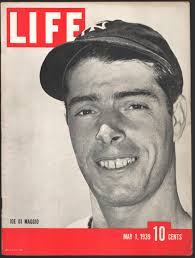 Life magazine front cover, May 1, 1939